How Did Martin Luther Impact Art and Artists in Europe
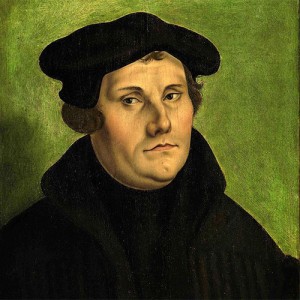
Martin Luther (1483-1546)
5 hundred years ago, on Oct 31, 1517 Martin Luther supposedly nailed his Ninety-v Theses to the doors of the Schlosskirche (Castle Church building) in Wittenberg, railing against Catholic Church corruption (in particular confronting the 'Sale of Indulgences') dividing Christianity, and igniting the Protestant Reformation. Many fortuitous events, such equally the protection of Frederick the Wise, Elector of Saxony, too as the support of other German princes, the invention of the Guttenberg's press press, Luther'due south friendship with the court painter and printer, Lucas Cranach the Elder, supported him in his endeavors and facilitated the spreading of his message.
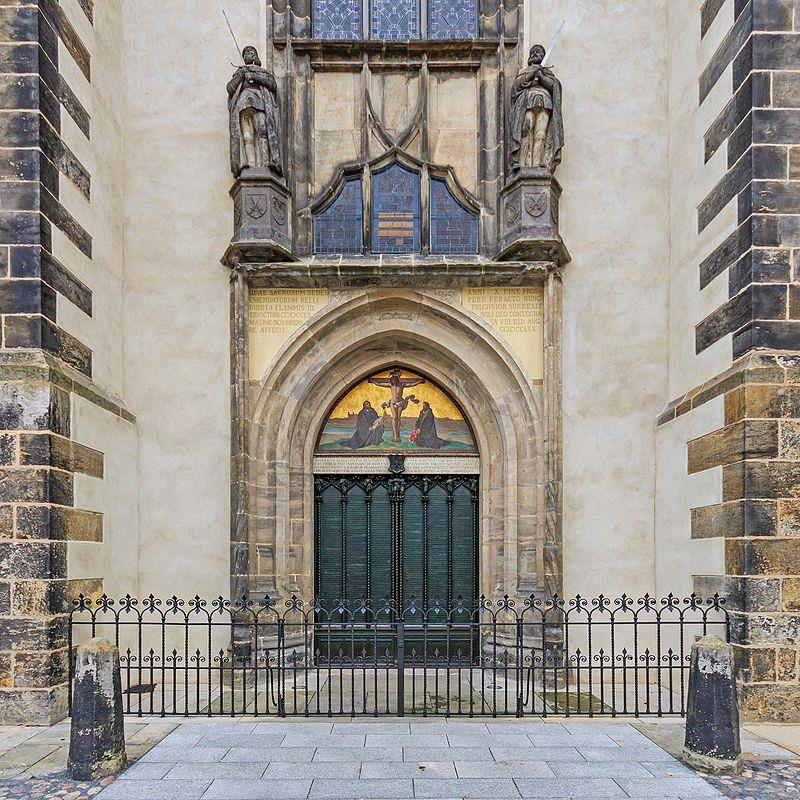 Luther's translation of the New Attestation into German made it non only possible for a wider audience to read the text, only it as well became the standard for the German linguistic communication. In fact, for many, it was the only book owned, which was then also used as a primer to teach children how to read.
Castle Church building in Wittenberg
According to gimmicky sources of his time, Luther was a powerful orator, using ingemination ('Der Herr ist mein Hirte/ The Lord is my Shepherd') and repetition in his sermons — a tradition deriving from his religious order, the Hermits of Saint Augustine. These monks, rather than living secluded in monasteries, were preaching friars, living inside their communities, and preaching in their respective colloquial languages rather than Latin. Luther became famous non simply through his oratories, but also equally a composer of many hymns, sung in German language, of which one of the most famous is 'Ein feste Burg ist unser Gott'/A steadfast castle is our God).
Luther considered these hymns important for his congregation in that they would foster the development of religion, since 'sola fide/by religion alone' and 'sola scriptura/by scripture solitary' became the ground of his belief that merely the Bible — at present available in German to all — could tell the truth.
Thomanerchor Leipzig "Ein feste Burg ist unser Gott" (EG 362)
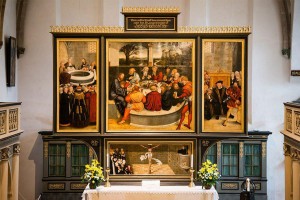
Chantry Painting by Lucas Cranach the Elder
His hymnal compositions were based in part on of import Church holidays (Appearance, Christmas, Easter, Pentecost, etc.), in office on diverse topics of the catechism (the Ten Commandments, the Lord'due south Prayer, the Eucharist), and in part on psalms and secular songs taken from High german folksong tradition. They were also an inspiration to Johann Sebastian Bach, who composed many simple hymns suited for congregational use. In his compositions, such as in the Saint Matthew and Saint John Passions, Bach alternates from chorus and orchestra with these simple choral melodies, creating a dialogue betwixt orchestra, singers and the listening public.
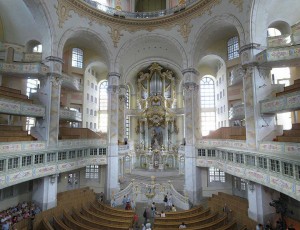
Interior of the newly rebuilt Frauenkirche in Dresden
With the Reformation, the compages and art of Protestant churches changed, as they were now devoid of religious decoration, of statues, representations of saints, relics and of traditional screens which had separated the nave with the praying public from the choir and chantry area, where priests and monks celebrated mass. The subject matter of paintings created during the Reformation changed likewise.
As tin be seen in Lucas Cranach'south Altarpiece, the iconography of the Reformation is depicted — on the left panel, the sacrament of Baptism, in the centre, the Last Supper of Christ (the Communion), on the correct console, the sacrament of Confession and in the Predella panel, Christ on the cross centrally placed, with Luther himself preaching to his followers, including his wife Katharina and his children.
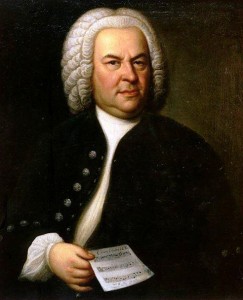
Johann Sebastian Bach (1685-1750)
In response to the upheaval of the Reformation, the Catholic Church also started to reform, using Ignatius of Loyola's the 'Spiritual Exercises' equally a footing — becoming the Counter-Reformation, the age of the Baroque, generally considered as the period betwixt 1650 and 1750. The Protestant Frauenkirche (Church of Our Lady) in Dresden, congenital between 1726 and 1743, is a testimony to the new concepts in Baroque architecture, i.eastward., a basilica type construction with no religious iconography, with perfect acoustics for the organ centrally placed behind the altar, and shut to the pulpit and the congregation — a perfect setting for the works of ane of the nigh important Baroque composers, Johann Sebastian Bach.
Frauenkirche Dresden J.S.Bach WO BWV 248 Teil half dozen Nr. 54 Chor "Herr wenn die stolzen Feinde"
Source: https://interlude.hk/martin-luther-impact-reformation-architecture-art-music/
0 Response to "How Did Martin Luther Impact Art and Artists in Europe"
Postar um comentário