The Sun Will Rise and We Will Try Again Origin
When will the sun die?
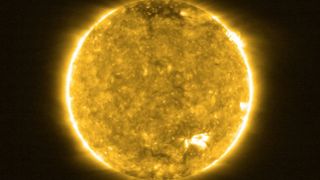
If yous worry near when the sun will die, never fear: that moment is billions of years away.
The dominicus gives energy to life on Globe, and without this star, we wouldn't be hither. Only fifty-fifty stars have limited lifetimes, and someday our lord's day volition die.
You don't demand to worry near this solar death anytime soon, though. Similar all stars, a churning fusion engine fuels the sun, and it withal has a lot of fuel left — about 5 billion years' worth.
Related: What'due south within the sun? A star tour from the within out
Why will the sunday dice?
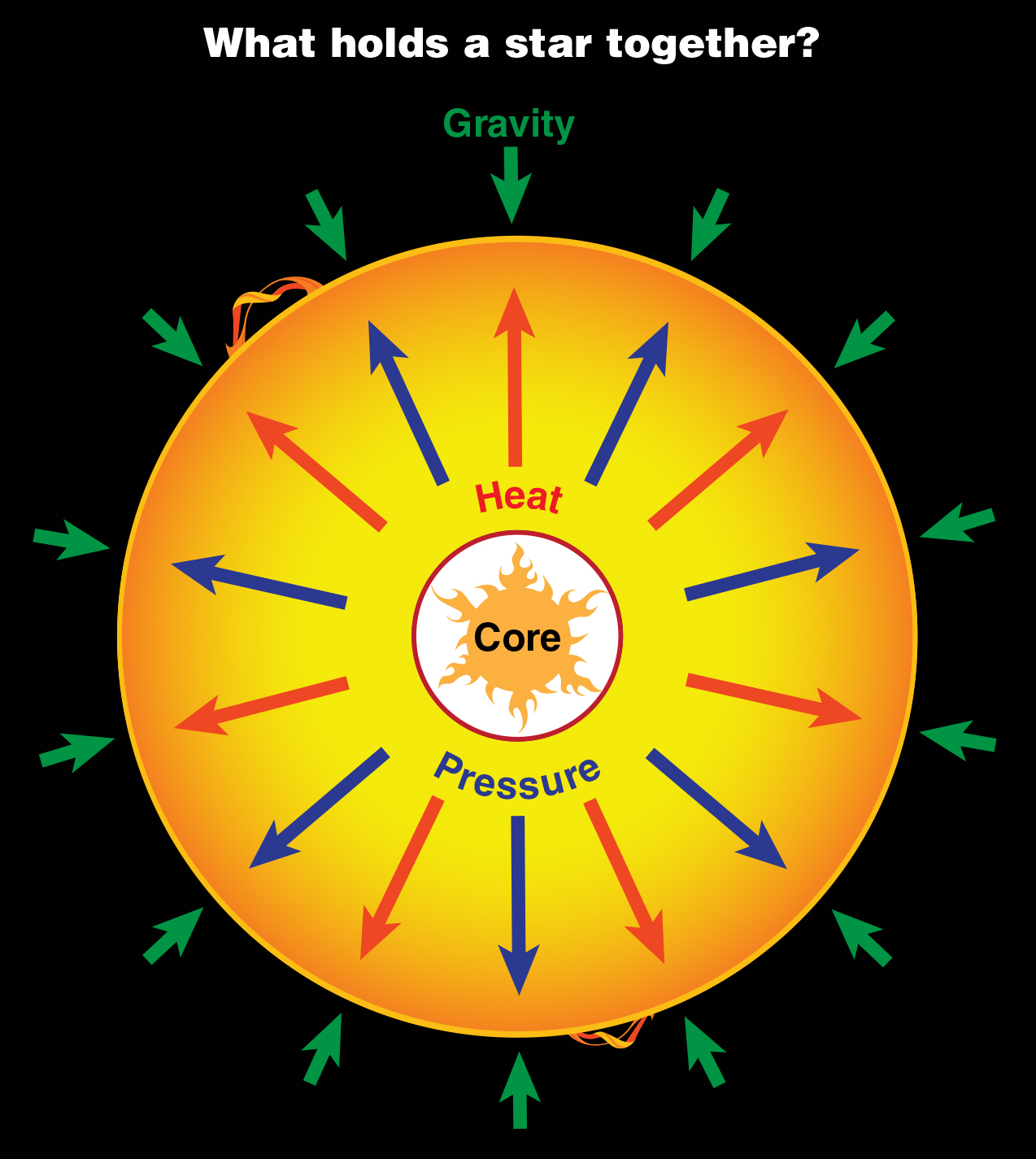
Stars like our sun class when a huge cloud of gas (mostly hydrogen and helium) grows and then large that it collapses under its ain weight. The pressure is so loftier in the center of that collapsing mass of gas that the rut reaches unimaginable levels, with temperatures so hot that hydrogen atoms lose their electrons.
Those naked hydrogen atoms then fuse together into helium atoms, and that reaction releases plenty energy to counter the intense pressure of gravity collapsing the cloud of gas. The boxing between gravity and the energy from fusion reactions fuels our sun and billions of other stars in our milky way and across.
But in about 5 billion years, the dominicus will run out of hydrogen. Our star is currently in the most stable phase of its life bicycle and has been since the germination of our solar system, most 4.5 billion years agone. Once all the hydrogen gets used upwards, the sun will grow out of this stable stage.
What will happen when the sun dies?
With no hydrogen left to fuse in the core, a shell of fusion hydrogen will class around the helium-filled cadre, astrophysicist Jillian Scudder wrote in an commodity for The Conversation. Gravitational forces will have over, compressing the cadre and allowing the residuum of the sun to expand.
Our star will abound to be larger than we can imagine — and then large that information technology will envelope the inner planets, including Earth. That'south when the sun will go a cherry-red giant, which it will remain for most a billion years.
So, the hydrogen in that outer core will deplete, leaving an abundance of helium. That element will and then fuse into heavier elements, like oxygen and carbon, in reactions that don't emit as much energy. Once all the helium disappears, the forces of gravity will take over, and the sun will shrink into a white dwarf. All the outer material will dissipate, leaving behind a planetary nebula.
"When a star dies, it ejects a mass of gas and dust — known every bit its envelope — into space. The envelope can be as much every bit half the star's mass," astronomer Albert Zijlstra of the Academy of Manchester in the United kingdom, said in a statement. "This reveals the star's core, which by this point in the star's life is running out of fuel, somewhen turning off and earlier finally dying."
Astronomers gauge that the sun has almost vii billion to 8 billion years left before it sputters out and dies. I fashion or another, humanity may well be long gone by then.
No supernova, no black pigsty
Our sun isn't massive enough to trigger a stellar explosion, chosen a supernova, when it dies, and it will never become a blackness hole either.
In order to create a supernova, a star needs about 10 times the mass of our sun. An object of that size would form a dense stellar corpse chosen a neutron star subsequently the explosion.
To leave behind a black hole, a supernova must occur in a star with near 20 times the mass of the lord's day.
Additional resource
Detect out what will happen to the Earth when the sun dies, from Live Scientific discipline. Learn more than most how stars form, evolve and dice from NASA, and learn more than virtually how the agency studies our sun. Lookout a mini documentary on the topic, The Death of the Sun, from PBS Infinite Fourth dimension.
Bibliography
- Gesicki, M., "The mysterious age invariance of the planetary nebula luminosity part brilliant cut-off," Nature Astronomy (2018). https://www.nature.com/articles/s41550-018-0453-9
- NASA, "Our Lord's day — In Depth," last updated Oct. 15, 2021. https://solarsystem.nasa.gov/solar-system/sun/in-depth/
- NASA, "Why the Sun Won't Become a Blackness Hole," Sept. 26, 2019. https://www.nasa.gov/image-feature/goddard/2019/why-the-sun-wont-become-a-black-hole
Join our Space Forums to keep talking space on the latest missions, nighttime sky and more than! And if you take a news tip, correction or comment, let u.s. know at: community@space.com.
Source: https://www.space.com/14732-sun-burns-star-death.html
0 Response to "The Sun Will Rise and We Will Try Again Origin"
Postar um comentário